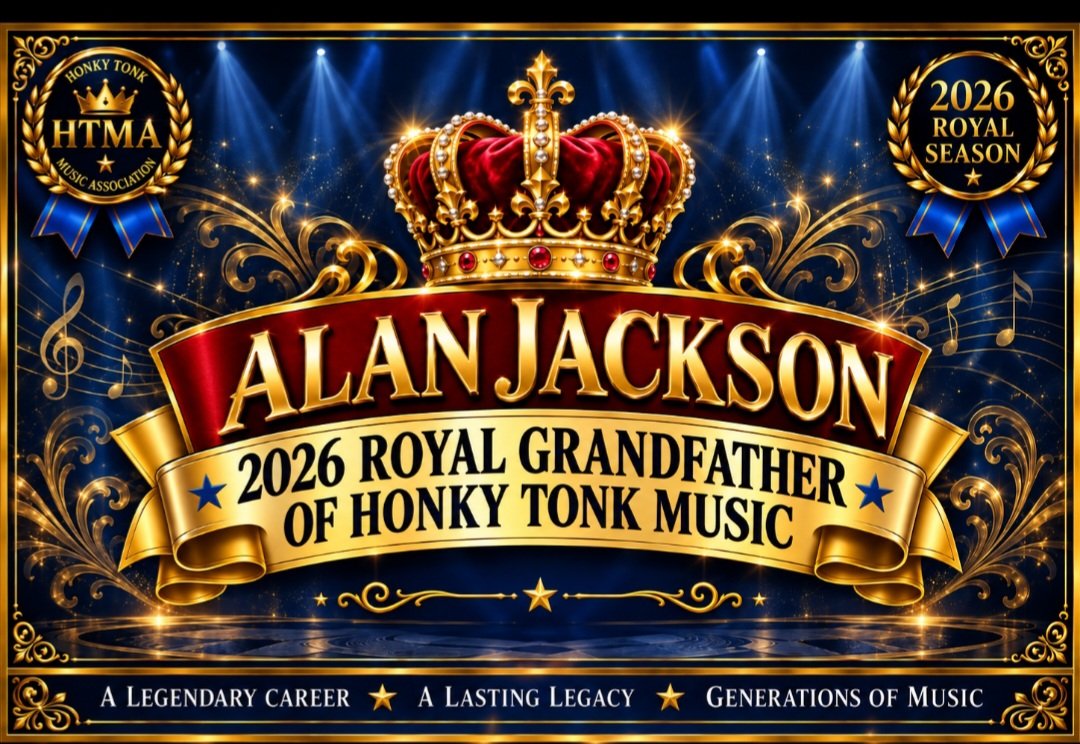
Alan Jackson — 2026 Royal Grandfather of Honky Tonk Music
2026 Royal Grandfather of Honky Tonk Music
There are awards that recognize a year and awards that recognize a song. Then there are honors that can only be understood by looking across a lifetime. The Honky Tonk Music Association named Alan Jackson the 2026 Royal Grandfather of Honky Tonk Music because Alan now stands in a very special place in country music history.
He belongs to a generation that once looked backward toward the men and women who built country music before him. Today, younger generations are looking backward toward Alan. They are learning his songs, studying his writing, hearing that unmistakable voice and discovering records Alan made decades before some of them were born.
A grandfather carries yesterday into today so tomorrow will know where it came from.
Before the Crown, There Was the Road
Alan Eugene Jackson was born in 1958 in Newnan, Georgia, one of five children. Long before country music knew his name, Alan knew what ordinary work looked like. His early years included jobs involving shoe repair, cars and furniture, carpentry and home building, mechanical work and operating a forklift.
Music was something he loved while real life still required him to work. Before there were awards and arenas, there was a young man trying to make room in ordinary life for a country music dream.
Alan Jackson — Here in the Real World
Alan married Denise in 1979. By 1983 he was writing songs and formed his first band, Dixie Steel. The name belongs to the earliest chapter of Alan’s musical road, before Nashville knew what was coming and before the recording career that would eventually carry his music around the world.
In 1985 Alan and Denise moved to Nashville, carrying with them the same kind of hope carried into that city by generations of singers and songwriters: perhaps somewhere there was a door that would open. A chance meeting between Denise and Glen Campbell helped create an important connection, and in 1986 Alan secured a songwriting agreement through Glen Campbell’s publishing organization. The road was beginning to move.
The Band That Traveled the Road With Him
Dixie Steel belongs to the beginning, but another band name would eventually become inseparable from Alan Jackson’s career: the Strayhorns. Their story reaches back farther than many people may realize. Some of the musicians who would become part of that longtime musical family were already playing with Alan before he signed his record deal with Arista Nashville.
Steel guitarist Robbie Flint and bassist Roger Wills were among the musicians whose history with Alan reached back into those early years. As Alan’s career grew, the Strayhorns became the band audiences around the world would see and hear beside him. Through changing decades, enormous stages and countless performances, they helped carry the traditional country sound that became so closely associated with Alan Jackson.
That matters in a story about legacy. The singer may stand at the center of the stage, but country music has always been built by musicians standing together. Alan has never treated the Strayhorns as though they were invisible people behind the star. He has publicly identified them as his band, giving the musicians who traveled the road with him their place in the story.
Quiet Does Not Mean Without Conviction
By 1989 Alan became the first country artist signed to Arista Nashville. Then came Here in the Real World, and country listeners heard something that sounded both new and deeply familiar.
And sometimes a country song begins in the most ordinary way imaginable. One of the stories tied to the Strayhorns eventually became the title of one of Alan’s defining records. At Geraldine’s, a truck-stop lounge in Doswell, Virginia, bassist Roger Wills warned Alan not to rock the jukebox because one of its legs was broken. The phrase stayed with Alan.
Out of an ordinary moment between Alan and one of his musicians came an extraordinary country hook: “Don’t Rock the Jukebox.”
Alan Jackson — Don’t Rock the Jukebox
Alan did not need to manufacture a country identity. It was already in the writing, the phrasing, the stories and that unmistakable Georgia voice.
Honky tonk was written all through Alan Jackson’s voice. We don’t have to explain that voice. We can hear it.
The Man Behind the Songs
The career that followed became enormous: number-one records, scores of Top 10 songs, millions of albums sold around the world and a catalog that became part of the soundtrack of modern country music. But the numbers alone do not explain Alan Jackson.
Alan Jackson — Someday
Alan is a songwriter. The words matter. The stories matter. The way a song makes ordinary life feel worth remembering matters.
His career eventually brought recognition from the Grand Ole Opry, the CMA, ACM and Grammy Awards, the Nashville Songwriters Hall of Fame, the Country Music Hall of Fame and the Songwriters Hall of Fame. Those honors document the career. The songs explain why the career lasted.
You Cannot Carry Country Forward If You Forget Who Carried It Before You
One reason Alan belongs in this Royal place is that his career has never existed as though country music began with him. He remembered the people who came first.
For the Honky Tonk Music Association, Hank Williams stands among our Guardian Angels. Alan’s “Midnight in Montgomery,” written with Don Sampson, reaches backward toward Hank and toward the history that still hangs over Montgomery.
Alan Jackson — Midnight in Montgomery
It is more than a song about a legendary singer. It is a reminder that the people who built this music do not simply disappear when their years on earth are over.
Respect Is Sometimes Something You Do
In 1999, country music saw another side of Alan’s respect for the people who came before him. George Jones had been asked to perform a shortened version of “Choices” at the CMA Awards and declined.
During Alan’s own scheduled performance, Alan stopped his song and sang part of “Choices.”
There are moments when an artist tells you who he is without needing a speech. That was one of them.
Strength Has Never Meant Hiding the Heart
Alan’s catalog has always had room for the jukebox, the highway, humor and honky tonk, but it has also had room for heartbreak, regret, memory, marriage, family and loss.
Alan Jackson — Tonight I Climbed the Wall
Traditional country music has never required a man to pretend he cannot hurt. Some of its greatest songs exist because somebody was willing to admit that he did.

Honoring Alan Jackson — 2026 Royal Grandfather of Honky Tonk Music
The People Who Live This Life Understand
The Honky Tonk Music Association was never created simply to look for what comes next. We certainly want to know who is coming next, but sometimes, before you can understand where you’re going, you have to turn around and remember who brought you this far. Alan has done that throughout his career. He remembered Hank, stood up for George Jones, and honored the songs and the people who helped build the country music world he eventually inherited. Somewhere while researching all of that for this article, something happened that we never expected.
We Went Looking for Alan’s Story — And Found Part of Our Own
We already knew why we had named Alan Jackson the 2026 Royal Grandfather of Honky Tonk Music. We didn’t go looking for reasons to justify the title; the honor had already been given. We were simply trying to tell Alan’s story. Then we started walking backward through his life, and things started looking familiar.
Before the awards, before the millions of records and before Nashville knew his name, Alan worked for a living while trying to find his place in country music. One of those jobs was in the mailroom at The Nashville Network. That stopped us, because years later another person trying to find her own place in country music would walk through those same doors. Today she is known as Bryangela Dusti Roads. Back then, she was known as Dusti Roads.
The name itself already carried country music history. She had chosen Dusti after Dusty Chandler, George Strait’s character in Pure Country. But another country voice had been part of her life much earlier.
Before Nashville, There Was a Record Player
Country music had been part of Dusti’s life long before she ever imagined that she would work inside the country music industry. When she was a little girl, her granddaddy gave her her first record player for Christmas. There was a record she wanted to hear on it, and her mama had to go find it for her as a Christmas present: Loretta Lynn’s “Coal Miner’s Daughter.”
Years later, that childhood record would follow her all the way into her own Nashville story. On a Saturday night at Gilley’s in Nashville, Dusti stood onstage with the Texas Dirt Road Band and sang the very song her mama had once gone looking for at Christmastime: “Coal Miner’s Daughter.”
The performance ended with a standing ovation. For Dusti, that was the night the stage name became real. The little girl who had wanted Loretta Lynn’s record for Christmas had grown up, come to Nashville and stood before an audience singing that same song as Dusti Roads.
George Strait’s Pure Country had helped give her the name. Loretta Lynn’s music had been there since childhood. Neither George nor Loretta could have known that they were becoming pieces of a story that would continue unfolding decades later.
Six Bags and a Microphone
Dusti’s road to Nashville wasn’t straight. She had left South Carolina wanting to sing country music. Life first took her north to Port Washington on Long Island, where she worked in Manhasset, and later to California. She traveled, worked and kept carrying that country music dream with her, even when life seemed to be taking her everywhere except Nashville.
In December 1993, Dusti was in England. By January 1994, she was in Scotland. And it was there, in Scotland, that she finally made the decision that would change the direction of her life: she was going to Nashville.
She returned to California, got rid of nearly everything, kept six bags of luggage and a microphone, and came to Tennessee in 1994.
More than thirty years later, while choosing Alan’s performances for this Royal tribute, that old journey suddenly collided with an Alan Jackson song Dusti had known for years: “Gone Country.”
She had heard the song before. But this time she heard it from the other side of all those years: South Carolina. Long Island. California. England. Scotland. And finally Nashville.
The characters in “Gone Country” are not Dusti’s biography. That isn’t the connection. What felt familiar was the movement—the road through different places and different chapters of life while something kept pulling her toward country music and, eventually, toward Nashville.
Alan Jackson — Gone Country
Then we noticed the year: 1994. The year Dusti came to Tennessee carrying six bags of luggage and a microphone was also the year Alan released Who I Am, the album that gave us “Gone Country.”
She had known the song for more than thirty years. She had just never heard her own journey inside it before.
Dusti had been watching and listening to the country artists who were defining that season of her life—Alan Jackson, Loretta Lynn, George Strait, Travis Tritt, Marty Stuart, Randy Travis, Clint Black, Reba McEntire and others. Their songs, their videos and the country music world they represented helped make Nashville feel like a place worth chasing.
Then Nashville Became Real
Before long, Dusti found herself working at The Nashville Network. She first worked as secretary to Tom Grissom. Later she worked with Dave Hart on American Skyline as a video production editor, contacting reporters around the country, gathering special reports and segments, reviewing what came in and helping coordinate the material that would become part of the television program.
More than thirty years later, while researching this article, we discovered that Alan had once worked inside that same network. He had worked in the mailroom before fame; Dusti came through years later, first as a secretary and then in television production. They weren’t there together, and they weren’t doing the same job. They were two people at two different times, working inside the same Nashville television world while there was still much more of both stories left to be written. Somehow, we had never known that until we started researching our Grandfather.
Loretta Was There Too
There was someone else who became part of that Nashville chapter in a much more personal way: Loretta Lynn. By then, Loretta’s voice had been part of Dusti’s story since childhood—from that first record player her granddaddy gave her for Christmas, to the copy of “Coal Miner’s Daughter” her mama had gone looking for, to the Saturday night when Dusti herself sang the song at Gilley’s and received a standing ovation.
Then, during that same period when Dusti was working at The Nashville Network, she had the opportunity to meet and talk with Loretta. Loretta was no longer simply a legendary voice coming through a record player or a song Dusti sang onstage. She became the first person within country music to personally give Dusti advice about the road she was trying to travel.
What Loretta told her that day belongs to another story. What matters here is that Loretta took the time to talk to a young woman who had come to Nashville with a country music dream. Dusti never forgot it. “Coal Miner’s Daughter” remained woven into Dusti’s own musical story, and Loretta would appear again among the country roots written into “Country Till the End.”
Looking back now, that conversation belongs to the same foundation we kept discovering while researching Alan’s story. Loretta was there. Alan was there. George Strait’s music was there. The Nashville Network was there. The songs were there. The Honky Tonk Music Association did not have a name yet, but some of the people and history that would eventually become part of its foundation were already there.
Then There Was CMT
During that same season of her Nashville life, Dusti also worked at Country Music Television. It was a different television world then. The videos weren’t digital files sitting on a computer; they were physical videotapes. The tapes had to be changed, the sequence had to be right, and each video had to be cued and ready when its time came to air. Among the artists on those tapes was Alan Jackson.
One of the artists Dusti had watched before making the decision to chase country music was now one of the artists whose videos were passing through the television world in which she worked. And Alan’s influence had already gone one step further.
Country Till the End
During those CMT years, Dusti wrote “Country Till the End,” creating both male and female versions. The song carried pieces of the country music that surrounded and inspired her. It referenced Garth Brooks, Loretta Lynn through “Coal Miner’s Daughter,” Reba McEntire, Patsy Cline—and Alan Jackson.
In the male version, sung by Josh Leonard, Alan is right there in the words: “I got that Alan drawl.”
That little line means something different today. Alan wasn’t simply one of the artists whose videotapes came through CMT. He had already found his way into one of Dusti’s songs. Decades before the Honky Tonk Music Association existed, before anyone thought about a Royal Grandfather of Honky Tonk Music, and before this article, Alan was already part of the story.
And Nashville Kept Connecting the Roads
Then there was Acuff-Rose Publishing and Opryland Music Group, where Dusti would become part of another side of the Nashville music world. Alan’s first publishing agreement had taken a different road, through Glen Campbell’s publishing company, but even here, while researching Alan, we kept finding little intersections.
Alan would record Tom T. Hall’s “Little Bitty,” a song from the Acuff-Rose publishing catalog. And when Alan became a member of the Grand Ole Opry, two men helped induct him: Roy Acuff and Randy Travis. There was Randy again, one of the artists Dusti had been watching before Nashville.
None of this was planned. We weren’t trying to connect dots. We kept finding dots that had already been connected.
And Suddenly, “Grandfather” Meant Even More
When we began this article, Alan Jackson was already our 2026 Royal Grandfather of Honky Tonk Music. Nothing we discovered created that honor. Something much more beautiful happened: we discovered why it felt so much like family.
The Honky Tonk Music Association didn’t really begin when somebody gave it a name. Its roots go farther back than that. They are in the songs we grew up hearing, those old videotapes, Nashville publishing offices, television studios and radio stations, the Grand Ole Opry, and little clubs where somebody walked onto a stage not knowing whether anybody would listen. They are in the people who worked all day and sang at night because they couldn’t imagine giving up either one.
And they are in the people who came before all of us: Hank Williams, our Guardian Angels, our pioneers, the Queens, the Kings, the songwriters and musicians, the people whose names everybody remembers and the people whose names history almost forgot. That’s our family.
That’s why Alan singing about Hank Williams matters to us. That’s why Alan standing up for George Jones matters to us. That’s why Loretta taking the time to speak to Dusti when she was a young woman with a country music dream matters to us. And that’s why discovering that Alan once worked at The Nashville Network before his dream came true touched something so deeply.
That’s why Grandfather is the right word. A grandfather carries stories from before the grandchildren were born. He remembers people they never had the opportunity to meet. He can reach backward into yesterday while standing with the family today, and eventually younger generations begin carrying his story.
Alan is standing in that place now. There was a generation before him, there was Alan’s generation, and now there are young singers who grew up hearing Alan Jackson as part of the foundation beneath their own dreams. That is what the Honky Tonk Music Association is supposed to protect: not just awards, but memory; not just what’s new, but what brought us here; not simply an industry, but a family.
Somewhere in the middle of researching our Grandfather’s life, Dusti realized why all of these little discoveries were touching her so deeply. TNN, CMT, Acuff-Rose, the Opry, Roy Acuff, Randy Travis, Loretta Lynn, George Strait, Hank Williams, Alan Jackson, those videotapes, the song she wrote, six bags of luggage and one microphone no longer felt like a collection of unrelated pieces. All those years later, the road felt as though it had been leading somewhere.
I’m home.
Not back at TNN. Not back at CMT. Not back in 1994. Home in the songs. Home in the history. Home among the people who came before us and the people who will come after us. Home in honky tonk.
Perhaps that was the most unexpected gift we received while writing Alan Jackson’s story. We went looking through the history of the man we had named our Royal Grandfather of Honky Tonk Music, and somewhere along the way, we discovered that we were already family.
This page belongs to Alan Jackson. The discoveries we made while researching his life simply helped us understand something more deeply about the man we were already honoring.
Alan’s life didn’t begin with fame. It began with family, work, songs, determination and a country music dream.
That is part of legacy too.
He remembered the people who came before him even after millions of people knew his name. And after all these years, his music is still capable of reaching into somebody else’s life and making an old song sound entirely new.
When the Music Becomes Service
A career this long eventually becomes about more than records. Alan has repeatedly used his music and public presence to help other people, including support connected with children’s causes, disaster relief, communities facing tragedy and institutions preserving country music history.
On September 17, 2000, Alan performed at Farm Aid in Bristow, Virginia. “The Blues Man” was already a song about the life behind the spotlight.
Alan Jackson — The Blues Man — Live at Farm Aid 2000
In that setting, the performance also became part of something larger than the performer himself. Music that had already spoken about the life of an artist was now being performed in service of people whose own lives and livelihoods mattered.
Faith, Home and Family
Behind the public career is the family story. Alan and Denise built a life together long before Nashville knew what would happen next. Their daughters—Mattie Denise, Alexandra “Ali” Jane and Dani Grace—grew up while their father’s songs were becoming part of country music history.
Alan Jackson — There’s a New Kid in Town
There is another piece of Alan’s history that says something about family and memory. As a teenager, Alan bought a 1955 Thunderbird and worked on it with his father. In 1979, the car was sold to help with the down payment on Alan and Denise’s first home.
Years later, Denise found the Thunderbird and bought it back for him. The car had become more than a car. It carried part of the family story.
What “Grandfather” Means to HTMA
The title 2026 Royal Grandfather of Honky Tonk Music is not about age alone. It recognizes Alan Jackson’s place in the living family tree of country and honky tonk music.
Alan learned from the generations before him. He protected their memory. He carried traditional country music through his own generation. Now artists and listeners who came later are looking toward Alan in much the same way.
That is the place of a grandfather in a musical family: remembering yesterday, standing in today and giving tomorrow something worth carrying forward.
Alan Jackson & Ali
2026 Best Father / Daughter Award — Country Music
Alan’s Royal story also reaches directly into the next generation through his daughter Alexandra “Ali” Jane Jackson. The Honky Tonk Music Association recognizes Alan Jackson and Ali as part of the 2026 Father / Daughter honors, celebrating something that cannot be manufactured by an industry: family.
The significance goes beyond two voices sharing a song. A father carries a lifetime of experiences that his daughter has seen from a place the audience never could. The stage may belong to the public for a few minutes, but the relationship belongs to them.
And Then We Remember
Eventually every long career becomes a collection of memories: the first jobs, the first songs, the first home, children growing up, people we loved, people we lost, places that disappeared and moments we did not realize were becoming history while we were living them.
Few Alan Jackson songs express that passage of time more directly than “Remember When.”
Alan Jackson — Remember When — Live From the 60th ACM Awards
Decades into his career, the song has become larger than one couple’s story. People hear their own years inside it. That is one of the things a song can begin to do after it has traveled with people long enough.
Royal Honors
Alan Jackson
2026 Royal Grandfather of Honky Tonk Music
2026 King of Honky Tonk Music
2026 Best Father / Daughter Award — Country Music
Alan Jackson & Alexandra “Ali” Jane Jackson
The Honky Tonk Dream Lives On
There was a time when Alan Jackson was simply a young man from Georgia trying to make enough room in ordinary life for an extraordinary dream. He worked. He wrote. He sang. He came to Nashville. And eventually, the world listened.
But the most important thing about a lasting career may be what happens after the world has listened for a very long time. The songs remain. The stories remain. The people who were young when they first heard them grow older. Their children hear them, and then another generation discovers them. Somewhere along that road, an artist becomes more than the man who made the records. He becomes part of the history the family passes down.
That is where Alan Jackson stands today.
Behind him are the people he remembered—people like Hank Williams and George Jones. Beside him is the generation that built country music with him. Coming behind him are singers and songwriters who may never know what country music sounded like before Alan Jackson was part of it.
So in the inaugural Royal season of the Honky Tonk Music Association, we honor the songwriter, the singer, the father, the keeper of history and the man whose music has now traveled far enough to belong to more than one generation.
2026 Royal Grandfather of Honky Tonk Music
The road behind you is now part of the road the next generation will travel.